The Oregon State Flag: History, Symbols and Why It Has Two Sides
The only state flag with a different picture on each side, and the first one was sewn in Portland.
- Published
- Reading
- 4 min
Quick answer
Oregon’s state flag is navy blue and gold, and it’s the only U.S. state flag with a different design on each side. The front shows the state escutcheon ringed by 33 stars, with “State of Oregon” above and “1859” below. The back shows a beaver. Governor Walter Pierce signed the flag into law on February 26, 1925.
- 1925
- Year Oregon adopted its state flag
- 33
- Stars, for the 33rd state
- 1859
- Year of statehood, on the front
- 2
- Different sides, the only state flag like it
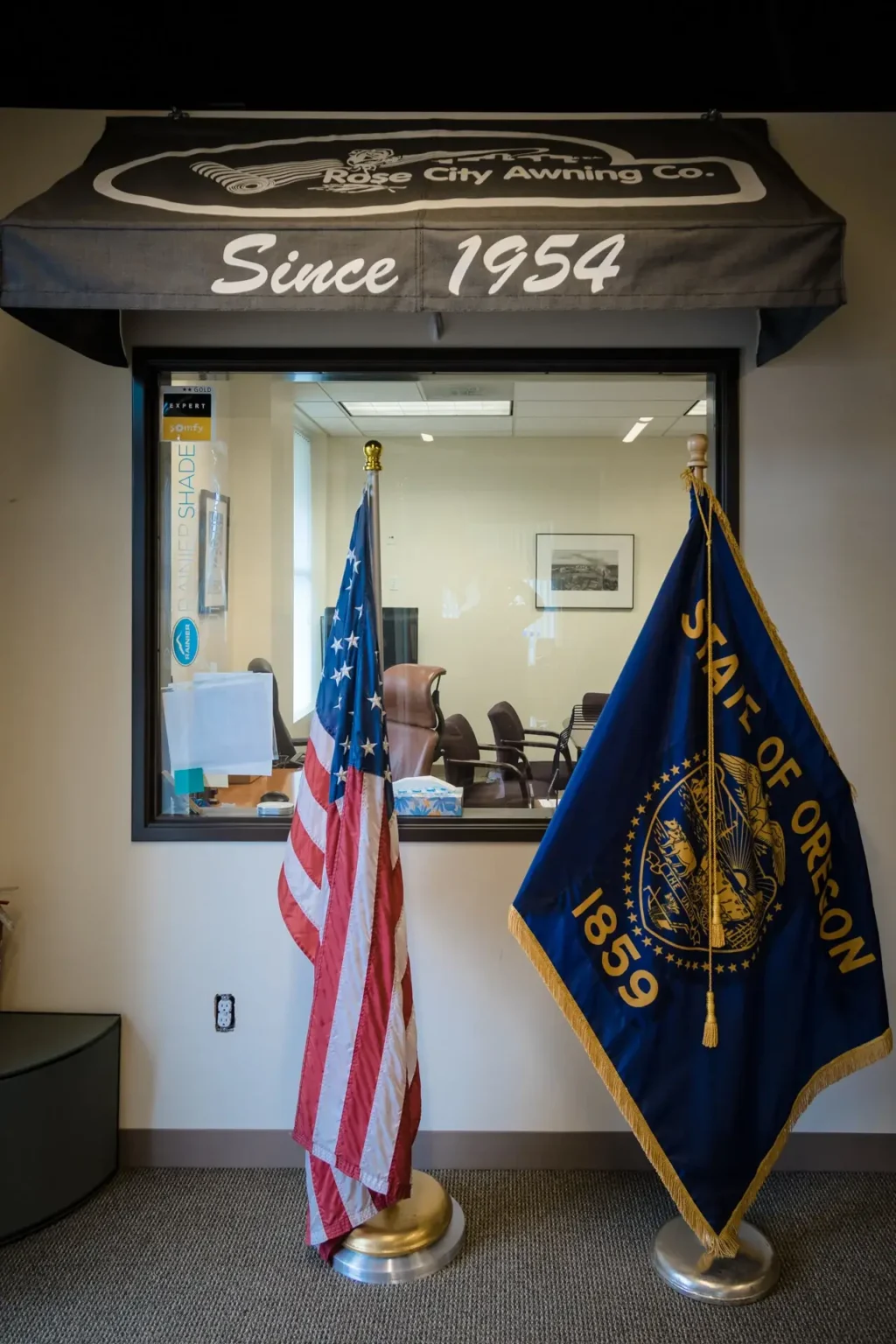
An indoor Oregon flag with gold fringe stands in our showroom on NW Nela Street, next to a U.S. flag, and people who come in for an awning sample often stop to look at it. It’s worth a closer look. Oregon’s flag is unusual among the fifty, and its story starts in Portland.
What’s on the front
The law that describes the flag, ORS 186.010, is short. One side bears “on a navy blue field the state escutcheon in gold, supported by 33 gold stars and bearing above the escutcheon the words ‘State of Oregon’ in gold and below the escutcheon the figures ‘1859’ in gold.” The same statute names navy blue and gold as Oregon’s official colors.
The escutcheon is the center of the state seal. The 33 stars stand for Oregon’s place as the 33rd state to join the Union, and 1859 is the year it did.
What’s on the back
The other side carries “a representation of the beaver in gold” on the same navy field. The Oregon Encyclopedia describes it as a beaver “perched on a log and facing to the right,” one of Oregon’s state symbols. Oregon is the only state whose flag has a different image on each side.
That has a practical side for a flag maker. Most single-layer flags simply show a mirror image on the back. Oregon’s can’t: the beaver has to be its own side.
A Portland story from 1925
Oregon was among the last states to adopt a flag. According to the Oregon Encyclopedia, it did so only after Portland’s postmaster, J.M. Jones, asked for a flag to present to the U.S. Post Office Department for a display. On February 26, 1925, Governor Walter Pierce signed Senate Bill 195, An Act Adopting a State Flag.
The design was based on Oregon’s nineteenth-century military flag, with different proportions and the beaver added to the back. Adjutant General George A. White asked the Meier & Frank department store in Portland to make the first one, and seamstresses Blanche Cox and Marjorie Kennedy finished it in time for the all-state flag display at the 150th anniversary of the Battle of Lexington in April 1925. A Portland shop, Portland hands, sewing a flag. We feel some kinship with that.
The first flag, lost and found
For decades, the original 1925 flag was thought lost in the 1935 fire that destroyed the state capitol. Then, during a 2008–09 contest run by The Oregonian to redesign the flag, which drew 2,500 entries and changed nothing, the original turned up framed in a stairwell of Pierce Library at Eastern Oregon University in La Grande. Governor Pierce’s grandson had donated it when the library was dedicated in his grandfather’s honor in 1954, the same year this shop opened.
Oregon law has required the state flag to be flown over schools, courthouses and other public buildings since 1953.
Sizes, and flying it with the U.S. flag
The official proportions are 500:833, height to width. In practice, as the Oregon Encyclopedia notes, flags are usually made at 3:5 or 2:3.
Flown with the U.S. flag, the Oregon flag goes below it on a single halyard, or on its own pole to the U.S. flag’s left (your right as you face them). The details are in our flag etiquette guide. The state’s other official symbols are listed in the Oregon Blue Book.
The Oregon state flag is in our state flags collection, alongside flags from other states. Or see it in person at the showroom; flags and flagpoles has the hours and what we carry.
Sources
- Oregon State Flag, The Oregon Encyclopedia, Oregon Historical Society
- ORS 186.010: State flag; official colors, Oregon Revised Statutes, Oregon State Legislature
- State Symbols, Oregon Blue Book, Oregon Secretary of State
- 4 U.S. Code § 7: Position and manner of display, Legal Information Institute, Cornell Law School
Questions
Oregon flag questions
Why does the Oregon flag have two different sides?
When Oregon adopted its flag in 1925, the law put the state escutcheon, 33 stars, “State of Oregon” and “1859” on one side and a gold beaver on the other. It remains the only U.S. state flag with a different design on each side.
What do the 33 stars on the Oregon flag mean?
They represent Oregon as the 33rd state to join the Union, in 1859.
When was the Oregon state flag adopted?
Governor Walter Pierce signed Senate Bill 195 adopting the state flag on February 26, 1925. The first flag was made by the Meier & Frank department store in Portland.
What is on the back of the Oregon flag?
A gold beaver on a navy blue field. The Oregon Encyclopedia describes it as perched on a log and facing to the right.
Where can I buy an Oregon flag in Portland?
Rose City Awning & Flag sells the Oregon state flag in its online state flags collection and has an indoor Oregon flag on display in its showroom at 2728 NW Nela St.
Keep reading
All journal postsFlag Etiquette: U.S. Flag Code Rules for Homes and Businesses
Flag etiquette made simple: when to fly the U.S. flag, how to hang it on a wall or in a window, where a state flag goes, half-staff and retiring a worn flag.
Types of Awnings: Retractable vs. Fixed vs. Metal, Compared for Portland
Retractable, fixed fabric, metal or freestanding: the four types of awnings compared on rain, wind, upkeep and looks, with a side-by-side table for Portland homes.
How to Clean an Awning: Fabric, Mildew and Winter Care in Portland
Brush, hose, mild soap, rinse, air-dry. The fabric maker’s method for cleaning an awning, the mix that lifts mildew, and how to get one ready for a Portland winter.