Patio Enclosure Ideas for Portland: Screens, Covers and Permits
Most Portland patios don’t need walls. They need the right sides, and a roof that sheds rain.
- Published
- Reading
- 6 min

Quick answer
The most flexible way to enclose a covered patio in Portland is with roll-down screens. Zip screens lock into side tracks against wind and bugs, then disappear into a slim headbox when you want open air. If the patio has no roof, start with a cover or canopy. In Portland, enclosing a patio cover, porch or carport requires a building permit.
“Enclose the patio” means something different to everyone who calls the shop. For some it’s a glass room. For most, it turns out to be simpler: a way to sit outside in May and October, out of the wind, away from the mosquitoes, without the low afternoon sun in their eyes.
Here are the five ways we see Portland patios and porches closed in, what each one is good at, and the permit question you’ll want answered before you order anything.
- 25 ft
- Widest single opening for the SummerSpace FlexShade Zip XL screen
- 5 in
- Height of the headbox the Zip XL rolls into
- 200 sq ft
- Portland’s permit threshold for an attached, open-sided patio cover
- 1 permit
- Needed in Portland to enclose a patio cover, porch or carport
Five ways to enclose a patio
1. Zip screens
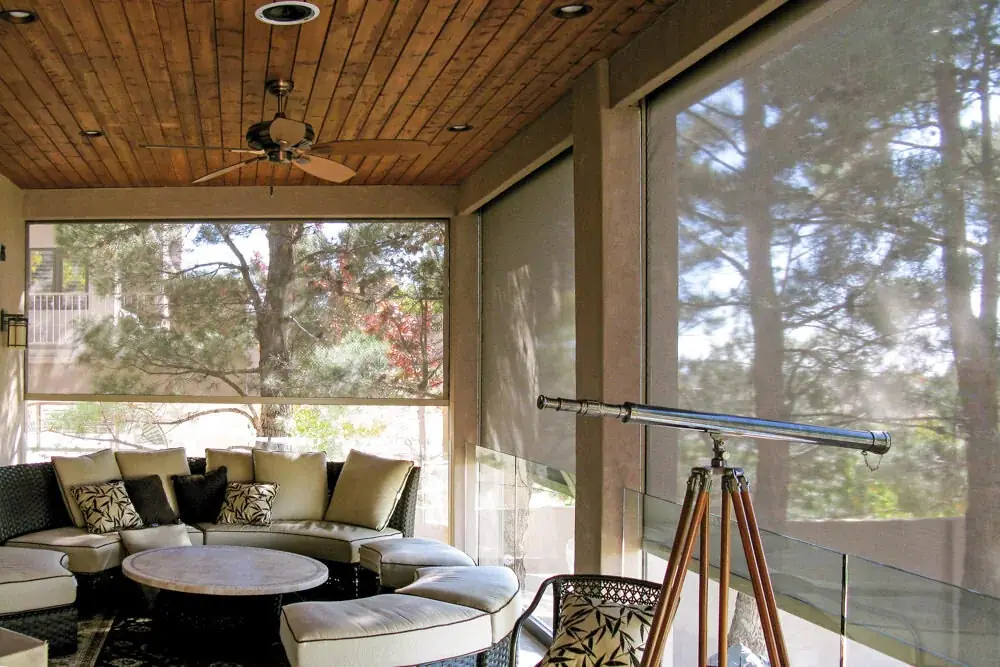
A zip screen is a roll-down screen whose side edges zip into tracks, so the fabric stays taut and doesn’t flap or blow out of its line. That makes it the strongest option for wind and bugs, and the system we install most for screen patio enclosures in Portland. The SummerSpace FlexShade Zip XL covers openings up to 25 feet wide and rolls into a 5-inch headbox. Screens can run on a motor or a manual crank, with solar mesh fabric if you want to keep the view, or solid acrylic awning fabric if you want privacy.
2. Drop screens
A drop screen (also called a drop shade or outdoor roller shade) hangs free rather than running in tracks. It’s simpler, often suits a porch with posts between bays, and handles low sun and privacy well. It’s less locked-down than a zip screen in a gust. We cover these in more detail in our guide to patio privacy screens.
3. A retractable awning, with or without screens
If the patio is open to the sky, a retractable awning gives you a roof on demand and rolls away when you want the sun. It isn’t meant to stay out in heavy rain or strong wind, so it suits a family that wants shade more than storm cover. Read our retractable awning guide before you choose this route.
4. A fixed canopy or patio cover
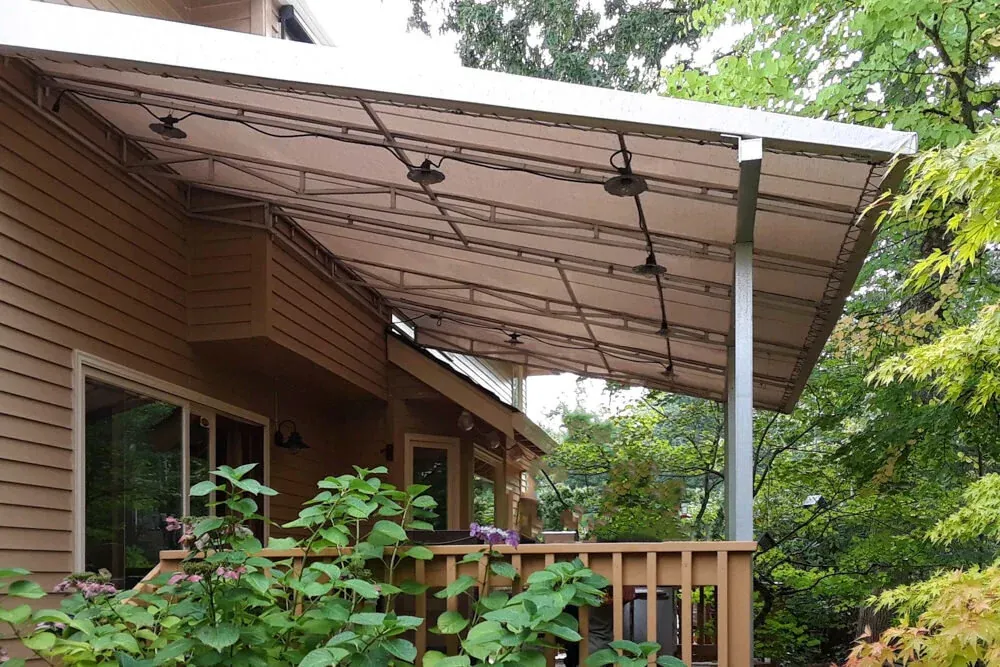
A canopy is a stationary fabric roof on posts or a welded frame, so it can stand away from the house over a patio, deck or BBQ area. Add screens to its sides and you have a true outdoor room that sheds rain all year. See patio covers and canopies for the types we build.
5. Framed walls or a glass sunroom
Walls and windows turn a patio into an addition. That’s a construction project for a general contractor, with a building permit, and it isn’t something an awning shop builds. Many people who start there find that a cover and a set of screens gives them most of the use for a fraction of the disruption.
Side by side
| Option | Overhead rain | Wind & bugs from the sides | Opens back up? |
|---|---|---|---|
| Zip screens | Needs a roof above | Best: edges locked in tracks | Yes, rolls into a headbox |
| Drop screens | Needs a roof above | Good for sun and privacy; edges free | Yes |
| Retractable awning | Light rain only; retract in storms | No sides unless screens are added | Yes, fully |
| Canopy or patio cover | Yes, all year | Add screens to close the sides | Roof stays; screens roll up |
| Walls or sunroom | Yes | Yes | No |
Start with the roof
Screens close the sides. They don’t keep rain off the table if there’s nothing overhead. So the first question is what’s above the patio now. If there’s a solid roof or porch cover, screens alone may get you there. If there’s open sky, decide between shade you can put away (a retractable awning) and a roof that stays (a canopy or cover), then add screens to the sides that catch the weather.
Commercial patios work the same way. Restaurants around Portland use screens to keep seating open into the shoulder seasons; Stormbreakers and Providence Park both have motorized screens we installed.


Do you need a permit to enclose a patio in Portland?
Often, yes. Portland Permitting & Development’s list of work that needs a residential building permit includes these two lines:
- Enclosing a patio cover, porch or carport.
- Adding or enlarging a porch cover, patio cover, carport or other open-sided roofed structure over 200 square feet that is attached to the house.
The same page lists work that usually doesn’t need a building permit, including a patio or porch cover not over 200 square feet that’s supported by an exterior wall, and window awnings no more than 54 inches deep, supported by an exterior wall, outside a design zone and not projecting past the property line. Zoning rules still apply even when a building permit isn’t needed, and environmental zones and flood areas add their own requirements.
The city’s list doesn’t single out roll-down screens, and whether a set of screens counts as “enclosing” depends on the project. That’s a question for the city, and it’s one we ask before you order. For storefronts and other commercial awnings, Portland City Code Chapter 32.52 sets the standards.
What’s the least expensive way to enclose a patio?
If you already have a roof over the patio, manual drop screens on the sides that catch the weather usually cost the least. Motors, side tracks, wider openings and more sides add to the price; so does building a roof where there isn’t one. Because every opening is a different width and height, we quote each project after a free consultation. What affects awning and screen cost in Portland walks through the factors.
Planning checklist
- Photograph each openingStraight on, and one from inside looking out. Note which side gets the afternoon sun and which side the wind comes from.
- Measure width and heightRough numbers are fine for a ballpark: width between posts or walls, and height from the beam to the deck or patio.
- Check what’s overheadSolid roof, porch cover, open pergola or open sky. This decides whether you need a cover first.
- Think about powerMotorized screens need power near the headbox. Manual cranks don’t.
- Send it to the shopUse the estimate form and add photos of the wall or space; phone photos are fine. We’ll tell you what fits and whether a permit applies.
Sources
- Do you need a permit for your home project?, Portland Permitting & Development
- Chapter 32.52: Awnings, Portland City Code
Questions
Patio enclosure questions
Do I need a permit to enclose a patio in Portland?
Usually. Portland lists enclosing a patio cover, porch or carport as work that needs a residential building permit, and an attached open-sided patio cover over 200 square feet needs one too. Whether roll-down screens count as enclosing depends on the project; we check what applies before you order.
What is the cheapest way to enclose a patio?
If the patio already has a roof, manual drop screens on the sides that catch the weather usually cost the least. Motors, side tracks, wider openings and adding a roof all raise the price.
What is the difference between a zip screen and a drop screen?
A zip screen’s side edges zip into tracks, so the fabric stays taut against wind and bugs. A drop screen hangs free, which is simpler and works well for sun and privacy, but its edges can move in a gust.
Can you enclose a patio that has no roof?
Screens close the sides but don’t stop rain from above, so an open patio needs something overhead first: a retractable awning for shade on demand, or a fixed canopy or patio cover for year-round rain cover. Screens can then be added to the sides.
Are motorized patio screens worth it?
Usually, if your covered patio or porch sits empty once the weather turns. Lowered screens shut out wind, rain, bugs and low sun; raised, they disappear into a slim headbox and the open air is back.
Keep reading
All journal postsPatio Cover Ideas: Fabric Canopies, Pergola Covers and Awnings
Six patio cover ideas: retractable awnings, fabric canopies, pergola covers, shade sails and cabanas. How each handles Portland rain, and which ones need a permit.
Shade Sails in Portland: Do They Work in Our Rain and Wind?
A shade sail is the lightest way to shade a patio. How custom shade sails are anchored and pitched for Portland rain, mesh vs. solid fabric, and when to skip one.
Types of Awnings: Retractable vs. Fixed vs. Metal, Compared for Portland
Retractable, fixed fabric, metal or freestanding: the four types of awnings compared on rain, wind, upkeep and looks, with a side-by-side table for Portland homes.
Thinking about one of these for your place?
Send a photo and a rough measurement. We’ll come back with what fits and a ballpark, from the shop on NW Nela Street.
- Call
- (503) 226-2761
- Showroom
- 2728 NW Nela St, Portland
Send us your project
Photos and rough measurements are often enough for a ballpark.